What Separates
Manananggal is a Tagalog word, and it is also a job description. It comes from the root tanggal, meaning to detach or come apart, so the name means roughly "the one who separates herself." In English she gets translated as a self-segmenting viscera sucker, or more plainly a winged upper-torso vampire. Both are accurate. Neither prepares you for the actual thing. She belongs to Philippine folklore, most at home in the central islands of the Visayas and the province of Capiz.
Is she real? That is the entire tension of this tale, so let us be clear up front. As a documented animal, a species anyone has caught or classified: no. As a belief that people have named, feared, and built specific defenses against for centuries, that still surfaces in village talk and local news: absolutely, and that is the more interesting kind of real. We will come back to that question directly, because it is the one everyone actually types into the search bar.
There are creatures of the night in every folklore tradition on earth. Vampires, spirits, demons in various configurations, things that live on the border between the living and the dead. Most of them are frightening in a recognizable way. They are large, or fast, or they take something from you. They are coherent. They make a kind of terrible sense. The manananggal does not make that kind of sense.
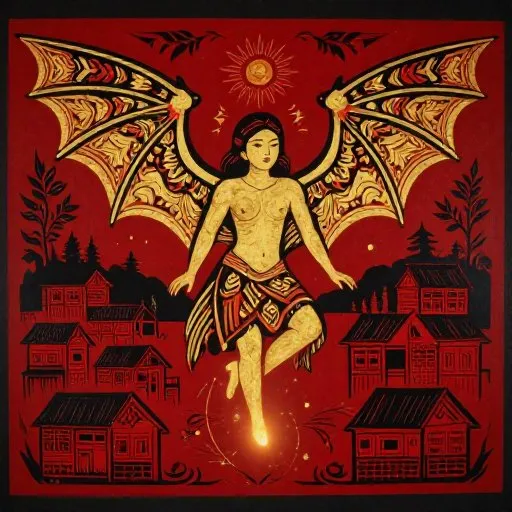
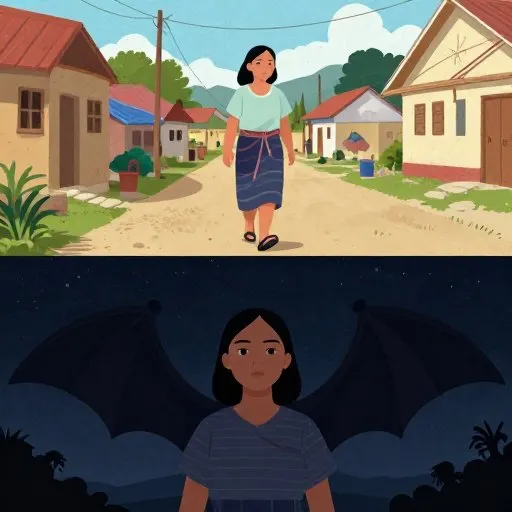
She appears human by day. A woman, usually, though the tradition does not strictly require it. She walks through the village. She knows her neighbors. She has a house. And at night, when she chooses, she rubs a special oil on her body, and something extraordinary and horrifying happens. Her torso separates from her legs at the waist. The lower half stays behind, standing or settled in a hidden place. The upper half sprouts enormous bat wings and lifts into the dark, trailing exposed entrails beneath it. The Filipinos who named her were being efficient. She is not a metaphor. She leaves her legs at home and goes flying. This is her whole thing.
What She Hunts
The manananggal hunts the pregnant and the sleeping.
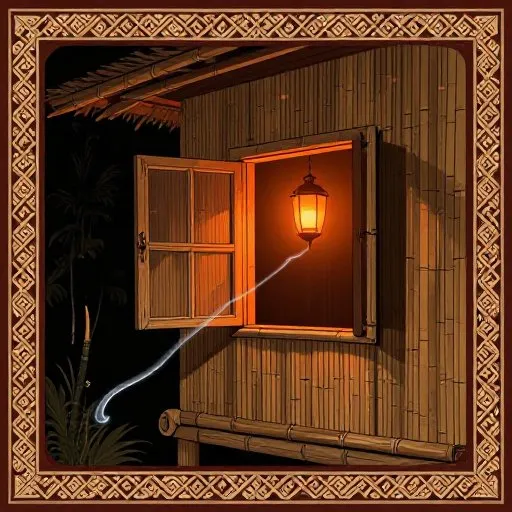
In the legend she settles on a roof and lowers a long tongue, thread-thin and impossibly extended, through the gaps in the thatch or the walls of the house to reach an unborn child. She is said to feed on blood, on the unborn, sometimes on the hearts and livers of the dead. The targeting of pregnant women is consistent enough across the Visayas, across Tagalog country, across dozens of islands, to suggest a specific cultural job. The manananggal is the story you tell to explain a certain kind of loss: the loss that has no cause anyone can point to, that arrives suddenly, that takes someone who had not yet arrived.
She can be sensed, if you know what to listen for. Her wings make a sound, a rushing or a soft clicking in the dark above the house. The old belief adds a cruel twist: the beat of her wings grows fainter as she comes closer, not louder, so that a family who hears her drifting away should understand she is nearly on top of them. When people heard it, they did not run. They acted. The tradition comes with a full kit of preventive measures, which is the mark of a folkloric creature that was genuinely useful as a system. It names the fear, it names the target, and it hands you the countermeasures.
She is not mindless. She chooses. She plans. She knows the village because she has lived in it, by daylight, as a person. That is the part that unsettles more than any forest monster that attacks whoever wanders in. She lives among the people she hunts. She is a neighbor.
Salt, Garlic, and the Legs

The manananggal is one of the few creatures in world folklore with a practical, specific weakness that does not require a hero.
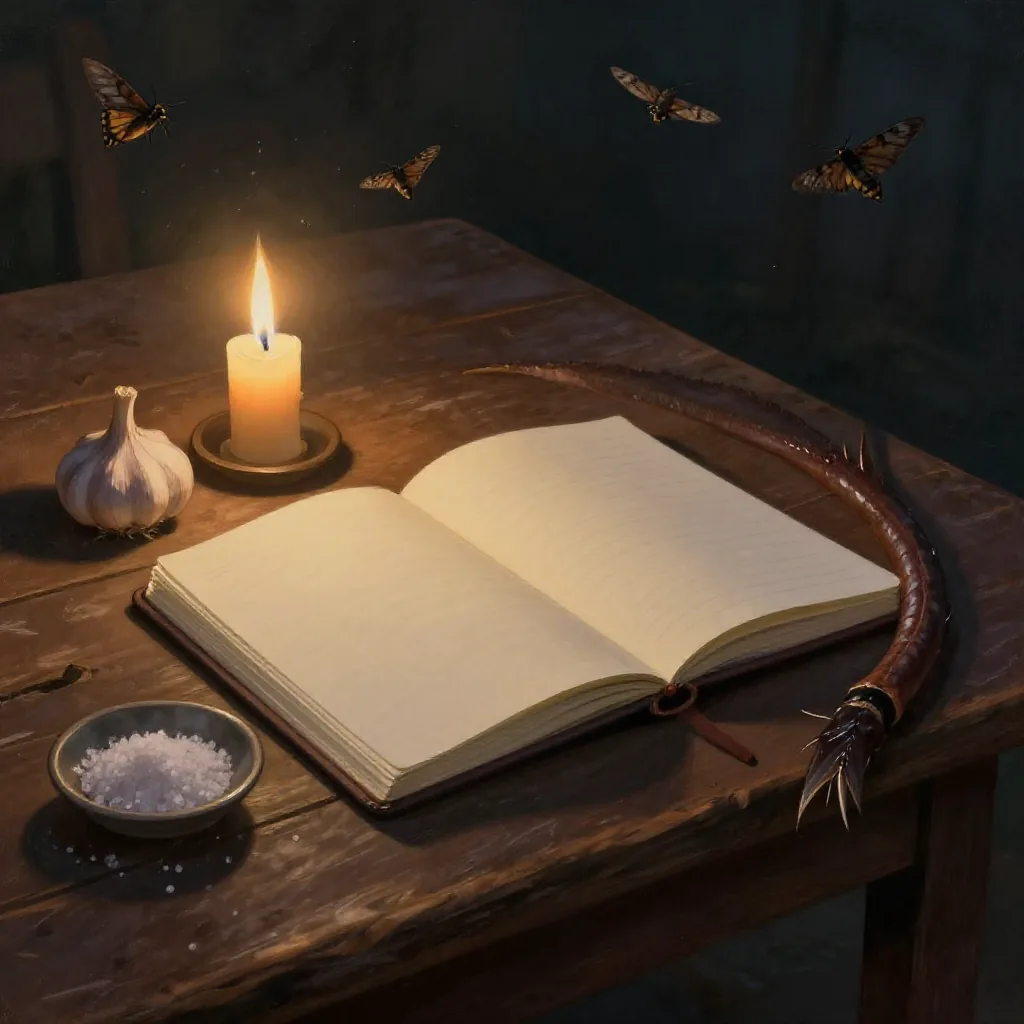
If you can find her lower half while she is away, you have options. Salt. Crushed garlic. Ash. Vinegar. Any of these scattered on the standing legs, or packed into the exposed cavity where her torso used to be, is said to prevent her from rejoining. She has to return before dawn. If she cannot reunite with her lower half before sunrise, she dies. This is not poetry. It is a structural vulnerability the tradition names out loud, so that ordinary people knew exactly what to do.
There is a striking plainness to the toolkit. The manananggal is terrifying, and she is also, in the right circumstances, undone by a kitchen ingredient. Salt: something every household kept. Not expensive, not rare, not reserved for priests or warriors. A grandmother who knew where the legs were and carried a pouch of salt could end her. The horror is balanced by agency. The tradition says: yes, this exists, and here is what you do about it.
Other defenses appear across the regional accounts, because folklore is not written by a committee. The tail of a stingray, the buntot pagi, dried stiff and used as a whip, turns up as a general weapon against the aswang. Garlic hung at windows and doorways. Vinegar and the pungent shrimp paste called bagoong, whose smell is said to keep her off. The list is long and inconsistent from island to island, but the principle never changes: she can be stopped, and it is regular people who stop her.
The Old Visayan World
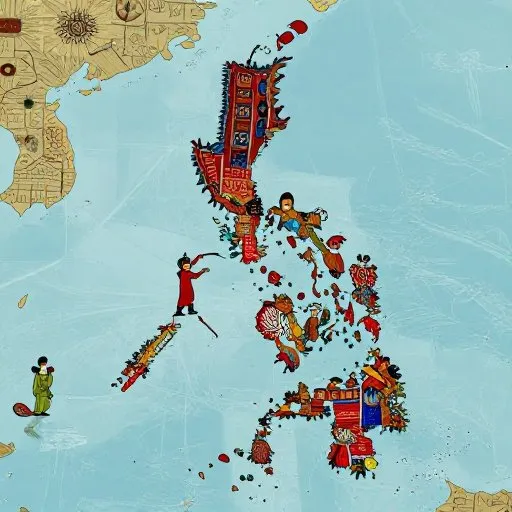
The manananggal comes from the Visayas, the central island region of the Philippines. The Visayan aswang tradition, the umbrella of shape-shifting evil spirits in Philippine folk belief, is deep and complicated, and the manananggal is one branch of it: specifically the one that comes apart from herself. She appears with the most frequency and the sharpest detail in Visayan accounts, and Capiz province, on the island of Panay, carries the strongest reputation of all.
The Visayas were a heart of precolonial Philippine culture. The people of these islands had sophisticated oral traditions, spiritual practice, and social structure long before the Spanish arrived in 1565. The aswang beliefs were woven into a worldview that treated the supernatural as adjacent to the natural rather than fenced off from it. The manananggal was not a story told to pass an evening. She was a real category of danger, met with real ritual precaution.
When Spanish colonizers came and began the long work of Catholic conversion, the aswang traditions did not vanish. They adapted. The manananggal took on some Christian framing: a wariness of holy objects, countermeasures like salt and garlic that rhyme with European vampire lore, an association with the demonic. But the core, the separation, the flight, the targeted hunting, stayed distinctly Filipino. She belongs to the Visayas in a way that outlasted more than four hundred years of foreign presence.
She is still discussed. Still reported. Still the subject of accounts from people in Visayan provinces who describe seeing her, hearing her, or finding the signs of her work. She is not a historical figure. She is a present one.
The Weight of Her

To sit with the manananggal, you have to sit with what she carries.
She is a woman, and she was a woman before she became this. Most tellings hold that the condition is not something she was simply born as but something transmitted: passed from one manananggal to a successor through a deliberate act of initiation, or inherited within a family, or laid on by a curse. In some accounts an aging aswang cannot die until she passes the burden to someone else, sometimes described as a black chick or a lump of something living that transfers mouth to mouth. So she carries two selves at once. A daytime life in a village that mostly does not know, and a night-self the village would kill if it could name her.
The Filipino scholars who have written about her note that she is not a flat villain. She is feared and she is hunted when found. She is also a figure of enormous power. She flies. She cannot be held by ordinary means. She transforms. The measures that stop her are measures a villager has to think of and actively carry out, in the dark, in time. She has survived for centuries, which means that most nights, in most villages, no one caught her.
She is terrifying because she is intimate. Because she looks like someone's neighbor. Because the things that wound most precisely, grief, sudden loss, the deaths that come without warning, tend to wear a familiar face until the moment they do not. Salt at the threshold. Garlic on the window. The wings in the dark above the roof, and then gone.
She Is Still Flying
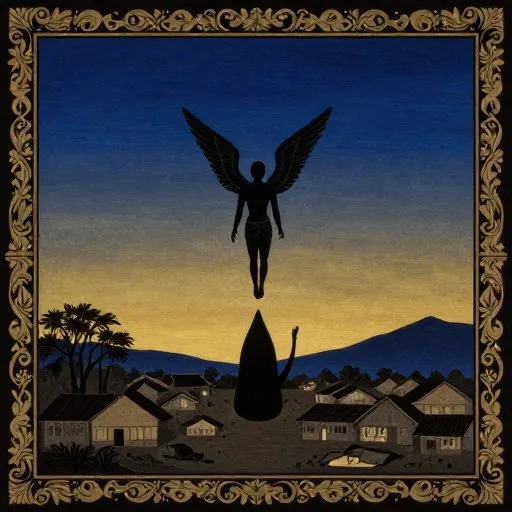
The manananggal is not a historical curiosity. She is a living tradition.
Reports and scares still surface in the Visayas and across the Philippines, and not only in the countryside. Aswang and manananggal panics have periodically moved through provinces and even city neighborhoods and drawn coverage in the local press, the way any deep-rooted fear resurfaces when something inexplicable happens and a community reaches for the framework it already has. Capiz has grown so tied to the belief that its reputation as aswang country is at once a national joke, a point of eye-rolling local frustration, and, honestly, a tourism hook. These are not just legends being retold. They are current anxieties running through a very old channel.
Philippine popular culture has fully claimed her. She recurs in film, in television, in komiks, and in contemporary horror, including the long-running Shake, Rattle and Roll anthology films that made her a household image for generations of Filipino moviegoers. She is a source of national identity as much as national fear. When the rest of the world manufactures vampire stories, the Philippines has one that does things no European vampire does, that reflects a specific set of fears and a specific kind of power belonging to the islands. She cannot be reduced to a local knockoff of something from elsewhere. She is her own.
She separates herself in the dark and flies over the villages, then returns to put herself back together before the sun. She has done this for a very long time. She knows the people below her, because she has been among them for generations, day-self walking the paths, night-self watching from above. Check the threshold. Put out the salt.
Aswang or Manananggal? Straight Answers, Since You Asked
What does manananggal mean? It is from the root tanggal, to detach or come apart, shared across Tagalog and the Visayan languages. So the word means, roughly, "one who separates herself." It is less a name than a live description of what she does every night.
What is she in English? There is no clean single word for her, which is part of the appeal. The translations people reach for are "self-segmenting viscera sucker" and "winged upper-torso vampire." She is closest to a vampire in the Western sense, but a vampire that unhooks her own top half from her legs and flies off on bat wings, which no European cousin bothers to do.
Is a manananggal the same as an aswang? Not quite, and this is the question the search engines keep asking, so here is the clean version. "Aswang" is the umbrella. It is the whole family of shape-shifting Philippine monsters, and it includes several distinct types: the plain viscera-eater, the weredog or were-beast that goes on all fours, the witch figure, the corpse-eating ghoul. The manananggal is one specific member of that family: the one defined by self-segmentation and wings. So every manananggal is an aswang, but not every aswang is a manananggal. When people in a province say "aswang," they may or may not mean the flying, half-bodied one. When they say "manananggal," they mean exactly her.
And is she real? As folklore, she is as real and as documented as any legend gets: named, feared, defended against, and still alive in the culture. As a creature you could photograph, she sits where every good tale on this site sits, in the gap between what people report and what anyone can prove. We are not going to close that gap for you. We are just going to note that plenty of households, for a very long time, have kept salt by the door anyway.
The Ones Who Also Come Apart

The manananggal is not the only creature in the region that comes apart at night. She sits inside a wider Southeast Asian family of detaching, flying, blood-drinking women, and the resemblances are close enough that they are worth setting side by side. The comparisons are real folklore, documented across borders, and they tell you something the Philippine version alone cannot.
In Malay tradition there is the Penanggalan, sometimes rendered as "detach" from the root tanggal, the same word at the heart of the manananggal's name. She is a woman by day whose head detaches at night and floats free with her stomach and entrails trailing beneath it, glistening. She too is drawn to pregnant women and newborns, and she is often tied in the stories to midwives. Households guarded against her by planting thorny pandan or jeruju leaves around the windows, so the trailing organs would snag as she tried to enter.
Further north there is the Krasue of Thai folklore, known as the Ahp in Cambodia and the Kasu in Laos: a floating female head with the heart, stomach, and intestines hanging below, often seen as a reddish glow drifting over rice fields and villages at night. Like the others, she is associated with feeding on blood and on the unborn, and with a human woman who looks perfectly ordinary in daylight.
Line them up and the pattern is unmistakable. Across three languages and several national borders, the same fear takes nearly the same shape: a woman who is a neighbor by day and a detached, airborne predator by night, hungry for exactly the most vulnerable members of the household. That does not prove any of them exist. It proves something arguably more interesting, that a very specific horror was arrived at again and again by peoples who told the story in their own tongue. The manananggal keeps her legs at home and her bat wings; the Penanggalan drops the body entirely; the Krasue glows over the paddies. Same waist-deep dread, three different answers to the dark.
Is the Manananggal Real? Reading the Reports

This is the question the site gets asked most about her, so it deserves a straight chapter of its own. Search "is manananggal real" or "manananggal true story" and you will find a lot of confident answers in both directions. The honest one sits in the middle, and it is more interesting than either extreme.
Start with what is documented, because that part is not in dispute. The belief is real and old. The name is real. The defenses are real practices that real communities have kept. Folklorists and Filipino scholars have collected manananggal accounts across the Visayas and Luzon for generations, and the tradition is stable enough that its details, the waist separation, the bat wings, the fading wingbeat, the salt in the cavity, recur from island to island with remarkable consistency. As a piece of living culture, she is as verifiable as any legend on this site.
Now the part everyone actually means by "real." No one has produced a manananggal. There is no specimen, no confirmed photograph, no captured half-body waiting for its top to return. What does exist is testimony: people who say they heard the wings, who say a neighbor was one, who describe finding the signs. Modern manananggal scares have swept through Philippine towns and even parts of the capital region within living memory and made the newspapers, usually when a run of unexplained deaths or a persistent rumor gave an old fear a new target. That is real reportage of a real social phenomenon. It is not the same as a captured creature, and we are not going to pretend it is.
So here is our verdict, in the house style. As a folk belief with centuries of documentation: entirely real. As a woman who splits at the waist and flies over your roof tonight: a mostly true tale, sitting in the gap where all the good ones sit. The gap is the point. It is also, apparently, no reason to stop keeping salt by the door.
Field Notes
- The name comes from the Tagalog and Visayan root "tanggal," meaning to detach, remove, or come apart. The word literally names the creature's defining act: severing her upper body from her lower half.
- The manananggal is one type of "aswang," the umbrella category of shape-shifting monsters in Philippine folklore. Belief is strongest across the Visayas, and Capiz province is the region most identified with aswang lore.
- Traditional defenses target the abandoned lower half: salt, crushed garlic, ash, or vinegar packed into the open cavity is said to stop her from reattaching before sunrise, which kills her. The dried tail of a stingray, the buntot pagi, used as a whip, is a widely cited aswang deterrent.
- In the legend she preys on the sleeping and on pregnant women, lowering a long thread-thin tongue or proboscis to reach an unborn child or drain blood. The beat of her bat-like wings is said to grow fainter as she comes closer, a detail meant to deceive listeners about how near she is.
- Spanish colonization of the Philippines began in 1565. Aswang beliefs predate the Spanish and survived more than four hundred years of colonization and Catholic conversion, absorbing some Christian framing while keeping a pre-Hispanic core.
- The manananggal remains a fixture of Philippine popular culture, recurring in horror films, komiks, and television from the twentieth century into the present.
Dig Deeper
Want the facts behind the folklore? Explore the real history of the Manananggal, Philippine aswang traditions, and Visayan culture.
Learn more about the Manananggal